📋 Table of Contents
- CISM Experience Requirements at a Glance
- The 5-Year Work Experience Rule
- What Counts as "Management" Experience
- Experience Across CISM Domains
- Experience Waivers and Substitutions
- The 10-Year Lookback Window
- How Verification Works
- Applying for CISM Certification
- Frequently Asked Questions
- Next Steps
One of the most common questions aspiring CISM professionals ask isn't about the exam itself — it's whether they actually qualify. The CISM work experience requirements are stricter than most certifications, and the language around "management experience" trips up a lot of candidates.
The good news: ISACA's rules are more flexible than they first appear. You don't need a management title, and a range of certifications and degrees can substitute for up to two years of experience. This guide breaks down every requirement clearly, so you can assess your eligibility before you invest time and money in exam prep.
CISM Experience Requirements at a Glance
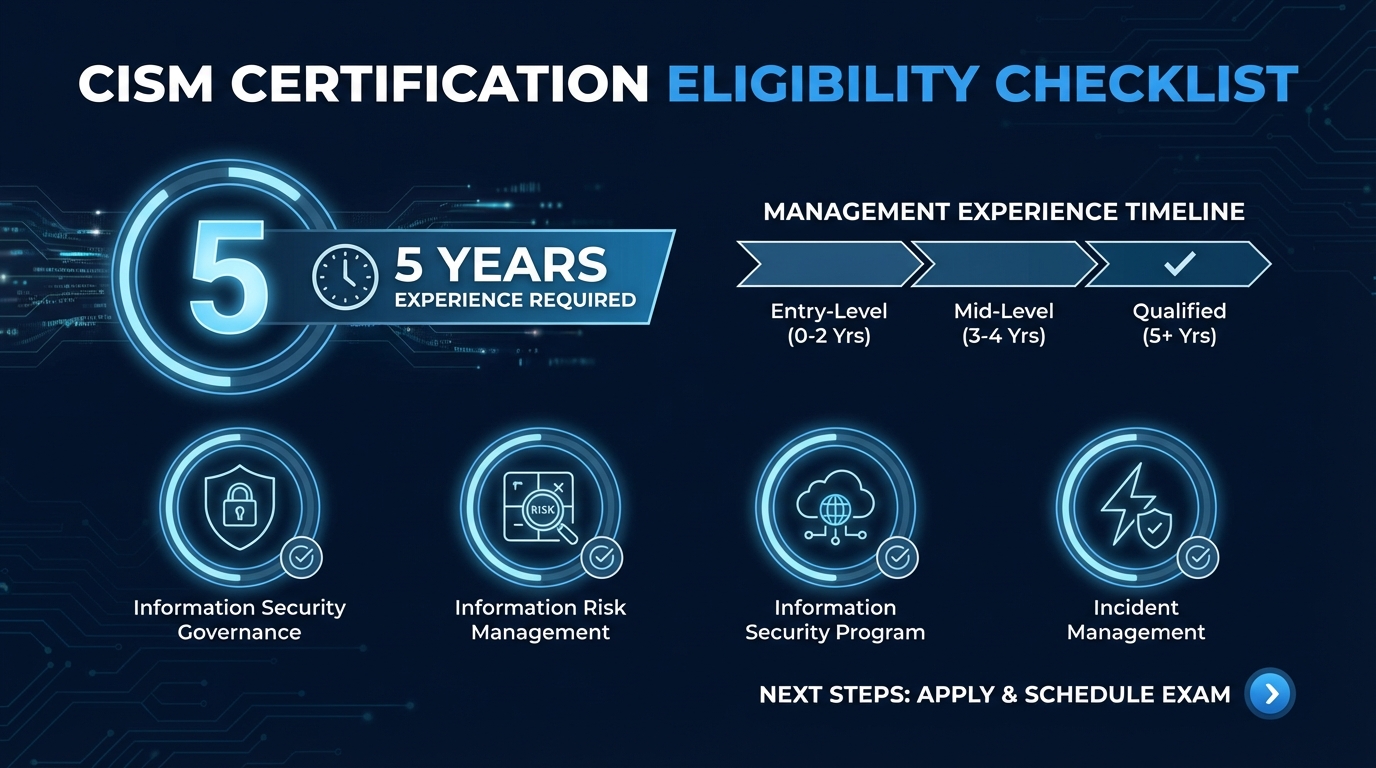
CISM Eligibility Checklist
- Total experience required 5 years of professional information security work experience
- Management experience required 3 years minimum in information security management
- Domains covered Management experience must span 3 or more of the 4 CISM domains
- Lookback window All experience must be earned within the past 10 years
- Max waivers allowed Up to 2 years via certification or education substitution
- Application deadline Within 5 years of passing the CISM exam
- Application fee $50 USD (in addition to the exam fee)
The 5-Year Work Experience Rule
To earn the CISM certification, you must have a minimum of five years of professional work experience in the field of information security. This is the baseline requirement — but it's not the only one.
Of those five years, at least three must be specifically in information security management, not just general infosec work. That's the critical distinction that catches a lot of candidates off guard: you could have a decade of security engineering experience and still not qualify without demonstrated management responsibilities.
What Counts as Information Security Experience?
Your five years of total experience can include a broad range of security roles, including:
- Security analyst, engineer, or architect positions
- Penetration testing and vulnerability assessment
- Security operations center (SOC) work
- Compliance, audit, and risk assessment roles
- Identity and access management (IAM)
- Security consulting or advisory work
- Network security and infrastructure protection
The key is that the work must be specifically in information security — general IT experience (help desk, systems administration, networking without a security focus) typically does not qualify unless it demonstrably involved information security responsibilities.
What Counts as "Management" Experience
This is where most candidates get confused. ISACA defines information security management experience broadly — and critically, you do not need a management title to qualify.
Management experience for CISM purposes means work that involves planning, directing, or overseeing information security activities at a strategic or programmatic level. It's about the nature of the work, not your job title or whether you have direct reports.
Examples of Qualifying Management Experience
✅ Counts as Management
- Developing security policies and standards
- Creating or overseeing security risk management frameworks
- Leading incident response planning and exercises
- Managing security programs or initiatives
- Coordinating security awareness programs
- Overseeing third-party security assessments
- Serving as a team or project lead on security projects
- Defining security metrics and reporting to leadership
❌ Typically Does Not Count
- Pure technical implementation (firewall config, patching)
- Help desk or IT support without security oversight
- General network administration
- Software development (unless security-focused)
- Physical security work
- Academic coursework or training
- Self-study and exam preparation time
Experience Across CISM Domains
Your three years of management experience can't all come from one area. ISACA requires that the management experience spans three or more of the four CISM domains. Understanding the domains helps you map your experience accurately when you apply. Learn more in our detailed CISM domains explained guide.
The Four CISM Domains (2026)
- Domain 1 (17%) Information Security Governance — Security strategy, governance frameworks, organizational structures, policies, and standards
- Domain 2 (20%) Information Risk Management — Risk identification, assessment, response, and monitoring; risk appetite and tolerance
- Domain 3 (33%) Information Security Program — Program development, resource management, awareness training, controls, and metrics
- Domain 4 (30%) Incident Management — Incident response planning, detection, containment, recovery, and post-incident review
In practice, most security managers naturally accumulate experience across multiple domains. A security manager who develops policy (Domain 1), runs risk assessments (Domain 2), manages the security program (Domain 3), and coordinates incident response (Domain 4) would easily meet the multi-domain requirement.
When completing your application, you'll describe your experience within each domain separately. Be specific about what you did and how it relates to each domain's job practice areas.
Experience Waivers and Substitutions
If you're close to the five-year requirement but not quite there, ISACA offers experience substitutions that can waive up to two years of the total experience requirement. Only one substitution can be applied, and documentation is required.
Available Experience Substitutions
2-Year Experience Waivers
- Certification: CISA Current Certified Information Systems Auditor (CISA) in good standing
- Certification: CISSP Current Certified Information Systems Security Professional (CISSP) in good standing
- Education: Graduate Degree MBA or master's degree in information security, information technology, information assurance, cybersecurity, or related field
General Information Security Experience Waiver
In addition to the formal substitutions above, ISACA allows candidates to count general information security work experience (non-management) toward the five-year total, up to a maximum of two years. This creates a path for candidates who have strong technical infosec backgrounds but are earlier in their management journey:
- Years 1–2: General information security experience (technical roles)
- Years 3–5: Information security management experience across 3+ domains
This structure means a candidate with two years of security analyst work followed by three years of security management responsibilities could qualify — even with the exact minimum experience.
Who Benefits Most from Waivers
The CISSP waiver is particularly valuable because many CISM candidates are mid-career security managers who already hold a CISSP. If you're in this camp, you could qualify for CISM with as little as three years of total infosec experience (two years waived by the CISSP, one year of additional qualifying experience — though you still need the three years of management experience in 3+ domains, so planning matters).
If you're already a CISSP holder weighing your certification options, check out our comparison: CISM vs CISSP: Which Is Better for Security Managers?
The 10-Year Lookback Window
All of your qualifying work experience must have been earned within the 10 years immediately preceding your CISM application, or within five years of passing the exam — whichever comes first.
This is an important constraint for career changers or candidates returning to information security after time away. Experience older than ten years will not count toward your application, regardless of how relevant it was.
How Verification Works
ISACA requires that your work experience be verified by a third party — typically a current or former supervisor, manager, or employer representative. This person must be able to confirm the dates of your employment and the nature of your security responsibilities.
What ISACA Verifies
- Employment dates (start and end)
- Job title and primary responsibilities
- That your described activities are accurate and representative
- The security management nature of your role
Verification Tips
A few practical tips to make verification smooth:
- Document as you go. Don't wait until you're applying to reconstruct your work history. Keep a running record of your security management activities, projects led, and responsibilities held.
- Choose accessible verifiers. Your verifier must be reachable by ISACA. Former managers who have left the company and changed contact information can create delays. Where possible, use HR contacts or multiple potential verifiers.
- Be specific in your descriptions. Vague descriptions like "responsible for security" are harder to verify. Specifics like "developed and maintained the enterprise risk assessment program, reporting quarterly to the CISO" give verifiers something concrete to confirm.
- Keep supporting documentation. Project documents, security program artifacts, and performance reviews you keep privately can help jog your own memory when writing descriptions, and may be requested if ISACA audits your application.
Applying for CISM Certification
Once you've passed the CISM exam and accumulated the required work experience, here's how the certification application process works:
Step-by-Step Application Process
- Pass the CISM exam. You can sit for the exam before meeting experience requirements. Your exam score is valid for five years.
- Log into your ISACA account. The work experience application is submitted through the ISACA member portal at isaca.org.
- Complete the work experience documentation. For each position, you'll describe your security management activities and map them to the relevant CISM domains.
- Provide verifier contact information. ISACA will contact your verifiers directly. Ensure they're aware and willing to respond promptly.
- Submit the $50 application fee. This is separate from the exam registration fee.
- Await ISACA review. Processing typically takes a few weeks. ISACA may contact you or your verifiers for clarification.
- Receive your certification. Once approved, you'll receive your CISM certificate and can officially use the designation.
CISM Continuing Education Requirements
Earning the CISM is just the beginning. To maintain it, you must:
- Earn 120 Continuing Professional Education (CPE) hours over each three-year renewal cycle
- Earn a minimum of 20 CPE hours per year
- Pay an annual maintenance fee to ISACA
- Report your CPE hours through the ISACA portal
CPE hours can be earned through security conferences, webinars, writing articles, mentoring, volunteering with ISACA chapters, and many other activities — not just formal training. For more on maintaining your certification long-term, check out our CISM study plan for tips on building habits that sustain your career development.
Frequently Asked Questions
Can I take the CISM exam before meeting the experience requirements?
Yes. ISACA allows candidates to sit for the CISM exam without having met the work experience requirements first. Your passing score is valid for five years, giving you time to accumulate and document the required experience before applying for certification. This is a popular approach — it lets you study and pass the exam at the right time in your career rather than waiting until you've fully met every requirement.
Do I need a formal management title to qualify?
No. ISACA evaluates the substance of your work, not your job title. Senior individual contributors, lead engineers, and principal analysts who perform strategic security activities — developing policy, leading risk assessments, managing programs, directing incident response — can qualify even without "manager" in their title. Focus on documenting what you did, not what you were called.
Can part-time or contract work count toward CISM experience?
Yes, part-time and contract work can count. However, ISACA applies the experience on a pro-rated basis. Part-time hours are calculated proportionally — for example, working 20 hours per week in an information security role counts as approximately half-time experience. Contract and consulting work also qualifies if it involved genuine information security management activities.
Does volunteer or non-paid security work count?
Generally, no. ISACA's experience requirement is for professional work experience, which implies compensated employment. Volunteer work, even if substantive and security-related, typically does not qualify for the experience requirement. However, it can still count toward your CPE hours after certification.
I have 8 years of IT experience but only 2 years in security. Do I qualify?
Not yet, based on that description alone. The five-year requirement is specifically for information security experience — general IT experience doesn't count unless it had explicit and demonstrable information security components. If your IT roles involved security responsibilities (e.g., managing firewalls, conducting risk assessments, implementing access controls), those activities may qualify. Review each position carefully and document the security-specific work you performed.
If I let my CISM lapse, do I have to reapply with new experience?
If your CISM lapses due to missed CPE requirements or non-payment of maintenance fees, the reinstatement process depends on how long the lapse has been. ISACA has a reinstatement policy that may require additional CPE hours or re-examination. You should contact ISACA directly if your certification has lapsed — don't assume you need to start over from scratch.
How does the CISM compare to CISSP experience requirements?
The CISSP requires five years of paid work experience in two or more of the eight CISSP domains — no specific management focus required. CISM's requirement for three years of management experience is more specific and targeted. For security professionals earlier in their careers, CISSP may be the more accessible first credential. For those already in management or governance roles, CISM's requirements may align naturally with their background. See our full CISM vs CISSP comparison for help deciding which to pursue first.
Next Steps: Assessing Your Eligibility
Before spending money on exam registration, it's worth taking thirty minutes to honestly assess your eligibility. Here's a simple framework:
Your CISM Eligibility Self-Assessment
- Add up your infosec years. List every position where you performed information security work, with dates. Calculate your total. Are you at five years (or three if applying a waiver)?
- Identify your management activities. Within those roles, list specific activities that qualify as information security management — policy development, risk oversight, program leadership, incident coordination. Do you have three years of this type of work?
- Check your domain coverage. Map your management activities to the four CISM domains. Do you have substantive experience in at least three?
- Consider waivers. Do you hold a CISSP, CISA, or relevant graduate degree? If so, you can reduce the total experience requirement by up to two years.
- Confirm the lookback window. Is all your qualifying experience from the past 10 years?
The CISM is one of the most respected credentials in information security management. The experience requirements exist to ensure that CISM holders have genuine, demonstrated management competence — not just theoretical knowledge. If you've been doing the work, the credential is within reach.
For those who want to complement their CISM preparation with additional practice tools, the CISSP.app study platform offers AI-powered question banks and gap analysis that many CISM candidates find useful for sharpening their strategic thinking around risk and governance.
Ready to Start Preparing?
Practice with thousands of expert-verified CISM and CISSP questions. AI-powered gap analysis tells you exactly where to focus.
Start Free 7-Day Trial →