📋 Table of Contents
- CISM Domains at a Glance
- Domain Weights and Exam Breakdown
- Domain 1: Information Security Governance (17%)
- Domain 2: Information Security Risk Management (20%)
- Domain 3: Information Security Program (33%)
- Domain 4: Incident Management (30%)
- How the Four Domains Connect
- Study Strategies by Domain
- Common Mistakes Candidates Make
- Frequently Asked Questions
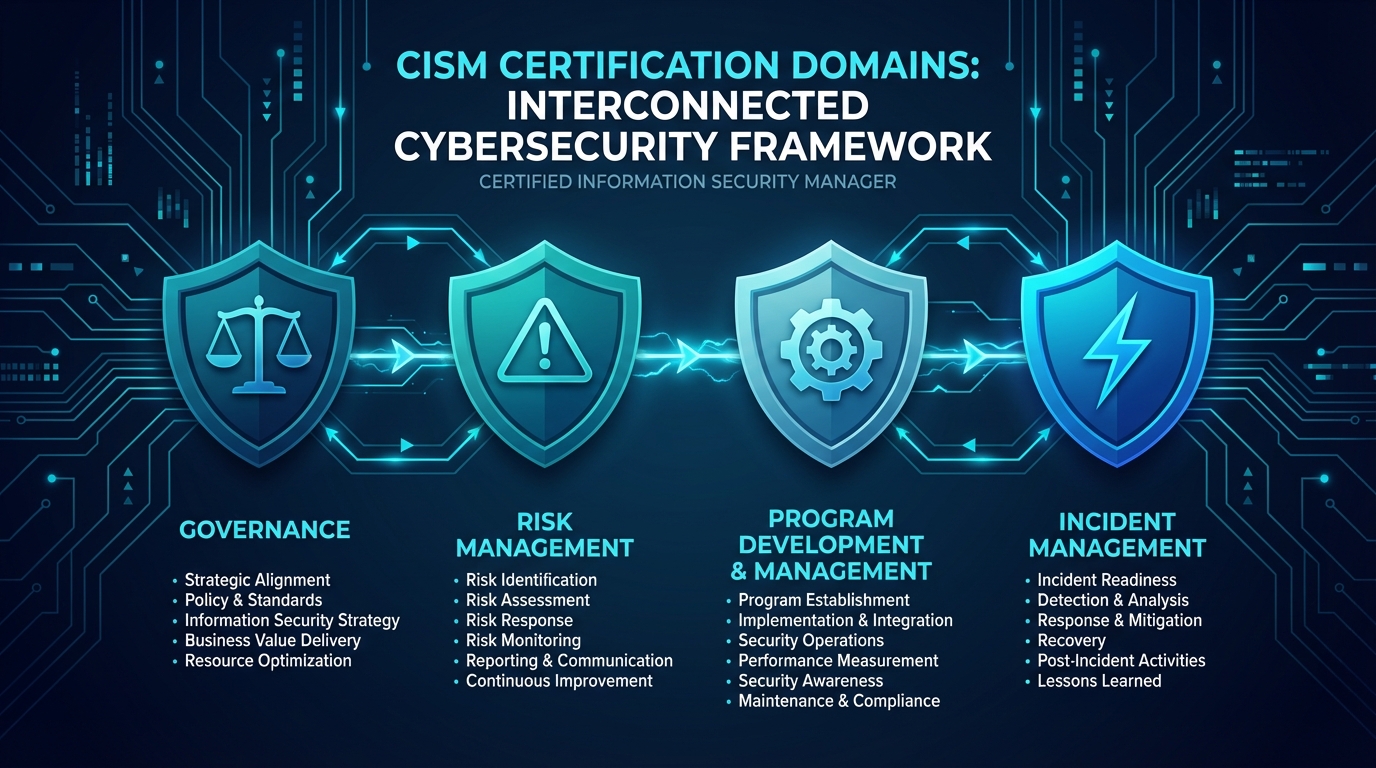
The Certified Information Security Manager (CISM) exam tests your knowledge across four distinct domains that together define what it means to manage enterprise information security. Since ISACA updated the exam content outline in June 2022, these domains have been refined to reflect how modern security managers actually work — balancing governance, risk, program operations, and incident response.
Understanding each domain's scope, weight, and key topics is the first step toward building an effective study plan. This guide breaks down every domain in detail, explains how they interconnect, and gives you practical strategies for mastering each one.
CISM Domains at a Glance
The CISM exam consists of 150 multiple-choice questions drawn from four job practice domains. You have four hours to complete the exam, and you need a scaled score of 450 out of 800 to pass. Unlike some certifications that weight domains equally, CISM distributes questions unevenly — and that distribution tells you exactly where to focus your study time.
The Four CISM Domains
- Domain 1 Information Security Governance — 17% of exam (~26 questions)
- Domain 2 Information Security Risk Management — 20% of exam (~30 questions)
- Domain 3 Information Security Program — 33% of exam (~50 questions)
- Domain 4 Incident Management — 30% of exam (~45 questions)
Domains 3 and 4 together account for 63% of the exam. If you're short on time, that's where the highest ROI lies. But don't neglect Domains 1 and 2 — governance and risk management provide the strategic foundation that the other domains build on.
Domain Weights and Exam Breakdown
The current CISM domain weights (effective since June 2022) shifted emphasis toward program management and incident response. The previous version of the exam weighted governance much more heavily. Here's what changed and why it matters:
Current Weights (2022+)
- Governance 17%
- Risk Management 20%
- Program 33%
- Incident Mgmt 30%
Previous Weights (Pre-2022)
- Governance 24%
- Risk Management 30%
- Program 27%
- Incident Mgmt 19%
The shift reflects a reality of modern security management: organizations need leaders who can build operational programs and respond to incidents, not just write policy documents. The exam now places more emphasis on doing than planning.
Domain 1: Information Security Governance (17%)
Information Security Governance is the strategic foundation of the CISM framework. This domain covers how security managers align security objectives with business goals, establish governance frameworks, and secure executive buy-in for security investments.
Despite being the smallest domain by weight, governance sets the direction for everything else. Without a clear governance framework, risk management becomes reactive, programs lack coherence, and incident response has no authority structure to lean on.
Key Topics in Domain 1
ISACA splits this domain into two major areas:
A — Enterprise Governance
- Organizational culture — How security awareness and accountability are embedded across the organization, not just in the IT department
- Legal, regulatory, and contractual requirements — GDPR, HIPAA, PCI DSS, SOX, and industry-specific regulations that shape security requirements
- Organizational structures, roles, and responsibilities — Reporting lines, the CISO's position in the org chart, and clear accountability for security outcomes
B — Information Security Strategy
- Strategy development — Creating a security strategy that maps directly to organizational goals and risk appetite
- Governance frameworks and standards — COBIT, ISO 27001, NIST CSF, and how to select and adapt frameworks for your organization
- Strategic planning — Budgets, resource allocation, and building business cases that justify security spending to the board
What ISACA Expects You to Do
The exam tests your ability to perform specific governance tasks:
- Identify internal and external influences that impact the security strategy
- Establish and maintain a security strategy aligned with organizational goals
- Build and maintain an information security governance framework
- Integrate security governance into corporate governance
- Develop business cases to support security investments
- Gain ongoing commitment from senior leadership
- Define and communicate security responsibilities throughout the organization
- Compile and present reports on security program effectiveness to stakeholders
Domain 2: Information Security Risk Management (20%)
Risk management is where security strategy meets reality. This domain covers how you identify, assess, and respond to information security risks across the enterprise. It's the analytical core of the CISM — the domain that turns governance frameworks into actionable decisions.
If you've worked with CISSP material, you'll find overlap in risk concepts. But CISM approaches risk from a management perspective, focusing on risk ownership, reporting, and organizational risk appetite rather than technical controls.
Key Topics in Domain 2
A — Information Security Risk Assessment
- Emerging risk and threat landscape — Tracking new threats from cloud adoption, AI, supply chain attacks, ransomware evolution, and geopolitical factors
- Vulnerability and control deficiency analysis — Identifying gaps between current controls and required protections, including technical and procedural weaknesses
- Risk assessment and analysis — Qualitative vs. quantitative methods, risk scoring models, asset valuation, and impact analysis
B — Information Security Risk Response
- Risk treatment options — Mitigation, transfer (insurance, outsourcing), acceptance, and avoidance — and knowing when each is appropriate
- Risk and control ownership — Assigning clear ownership to business units (not just IT), establishing accountability frameworks
- Risk monitoring and reporting — Key Risk Indicators (KRIs), risk registers, dashboard reporting, and escalation procedures
Risk Assessment Methods You Need to Know
- Quantitative ALE = SLE × ARO — calculates dollar loss expectancy. Best for justifying security spend to executives.
- Qualitative Uses categories (High/Medium/Low) or scoring scales. Faster, more flexible, used when data is limited.
- Semi-Quantitative Combines both — numerical scales (1-5) that approximate but don't claim precise dollar values.
- FAIR Framework Factor Analysis of Information Risk — decomposes risk into measurable factors for more rigorous quantitative analysis.
Domain 3: Information Security Program (33%)
This is the largest and most important domain on the CISM exam. At 33% of the total, it accounts for roughly 50 questions. The domain covers everything involved in building, running, and maturing an enterprise security program — from resource allocation and policy development to control implementation and third-party management.
While governance sets the "what" and "why," and risk management identifies the "where," the security program domain is all about the "how." This is operational security management at its most comprehensive.
Key Topics in Domain 3
A — Information Security Program Development
- Program resources — People (staffing, skills gaps, training), tools (SIEM, DLP, IAM platforms), and technologies (cloud security, zero trust architecture)
- Asset identification and classification — Data classification schemes, asset inventories, crown jewel analysis, and data flow mapping
- Industry standards and frameworks — Implementing ISO 27001, NIST SP 800-53, CIS Controls, or SOC 2 within your program
- Policies, procedures, and guidelines — The policy hierarchy from board-level policy down to operational procedures and technical standards
- Program metrics — KPIs, maturity models (CMMI), security scorecards, and metrics that demonstrate program effectiveness
B — Information Security Program Management
- Control design and selection — Choosing controls based on risk assessment results, cost-benefit analysis, and regulatory requirements
- Control implementation and integration — Rolling out controls without disrupting business operations, managing change
- Control testing and evaluation — Penetration testing, vulnerability assessments, audits, and continuous monitoring
- Security awareness and training — Building a security culture through targeted training programs, phishing simulations, and executive briefings
- External services management — Vendor risk management, third-party assessments, SLAs, cloud provider security, and fourth-party risk
- Communications and reporting — Reporting security posture to stakeholders, dashboards, and translating technical findings into business language
Practical Focus Areas
The exam tends to emphasize these operational realities:
- Third-party risk is increasingly tested — know how to assess vendor security, manage outsourced security services, and handle supply chain risk
- Metrics and reporting questions test whether you can communicate program effectiveness to non-technical stakeholders
- Security awareness programs must be tied to organizational risk — generic "annual training" answers are usually wrong
- Policy lifecycle — creation, approval, distribution, enforcement, review, and retirement
Domain 4: Incident Management (30%)
Incident Management is the second-largest domain at 30% of the exam. This domain covers everything from building incident response capabilities to managing active incidents and conducting post-incident reviews. It's where governance, risk, and program operations are tested under pressure.
The 2022 exam update nearly doubled this domain's weight (from ~19% to 30%), reflecting the increasing frequency and severity of security incidents. Organizations need security managers who can lead through a crisis, not just plan for one.
Key Topics in Domain 4
A — Incident Management Readiness
- Incident Response Plan (IRP) — Documented procedures for detecting, analyzing, containing, eradicating, and recovering from security incidents
- Business Impact Analysis (BIA) — Identifying critical business processes, maximum tolerable downtime (MTD), recovery time objectives (RTO), and recovery point objectives (RPO)
- Business Continuity Plan (BCP) — Maintaining essential functions during and after a disruption
- Disaster Recovery Plan (DRP) — Technical recovery procedures for IT systems and data
- Incident classification and categorization — Severity levels, triage procedures, and escalation criteria
- Training, testing, and evaluation — Tabletop exercises, functional drills, full-scale simulations, and lessons-learned integration
B — Incident Management Operations
- Tools and techniques — SIEM correlation, forensic tools, threat intelligence feeds, and automated response (SOAR)
- Investigation and evaluation — Root cause analysis, evidence preservation, chain of custody, and forensic procedures
- Containment methods — Network isolation, account lockouts, system quarantine — balancing containment with business continuity
- Response communications — Internal escalation, executive notification, legal and regulatory reporting requirements, and public communications
- Eradication and recovery — Removing threats, patching vulnerabilities, restoring systems, and validating clean recovery
- Post-incident review — After-action reports, root cause documentation, process improvements, and updating response plans
Key Recovery Metrics to Know
- RTO (Recovery Time Objective) Maximum acceptable time to restore a system after a disruption
- RPO (Recovery Point Objective) Maximum acceptable data loss measured in time (e.g., last 4 hours of transactions)
- MTD (Maximum Tolerable Downtime) Total time a business can survive without a critical function before suffering irreversible damage
- MTTR (Mean Time to Recover) Average time to restore normal operations — a key operational metric
How the Four Domains Connect
The CISM domains aren't isolated silos — they form a continuous management cycle. Understanding how they interconnect is crucial for exam success and real-world application:
- Governance → Risk: The governance framework defines risk appetite and tolerance levels. Risk management operates within those boundaries.
- Risk → Program: Risk assessment results drive control selection and resource allocation within the security program.
- Program → Incidents: A well-built security program includes incident response capabilities. Controls that fail under attack reveal program gaps.
- Incidents → Governance: Post-incident reviews feed back into governance, triggering strategy updates, policy changes, and revised risk assessments.
Many CISM questions test your understanding of this cycle. When an incident reveals a control gap, the correct management response isn't just "fix the control" — it's "assess the risk impact, update the program, report to governance, and adjust the strategy."
Study Strategies by Domain
Your study time should roughly mirror the domain weights, with adjustments based on your experience. Here's a recommended allocation:
Recommended Study Time
- Domain 1 (17%) 15-20% of study time
- Domain 2 (20%) 20-25% of study time
- Domain 3 (33%) 30-35% of study time
- Domain 4 (30%) 25-30% of study time
Total Prep Estimate
- With experience 150-200 hours over 8-10 weeks
- Without experience 250-350 hours over 12-16 weeks
- Practice questions 500-1,000 minimum recommended
- Review period Final 2 weeks — focus on weak domains
Domain-Specific Tips
For Domain 1 (Governance): Focus on understanding governance frameworks at a strategic level. You don't need to memorize every ISO 27001 control, but you need to know when and why to use different frameworks. Read board-level security reports if you can find examples.
For Domain 2 (Risk Management): Practice both qualitative and quantitative risk calculations. Understand the ALE formula cold (ALE = SLE × ARO). More importantly, know when quantitative analysis is appropriate vs. qualitative — the answer depends on data availability and organizational maturity.
For Domain 3 (Program): This domain rewards breadth. Study control frameworks, vendor management processes, awareness training best practices, and security metrics. Practice scenarios about managing competing priorities with limited budgets.
For Domain 4 (Incident Management): Know the incident response lifecycle inside and out: preparation → detection → analysis → containment → eradication → recovery → post-incident. Memorize the BIA metrics (RTO, RPO, MTD) and understand how BCP and DRP relate to each other.
Common Mistakes Candidates Make
After reviewing thousands of CISM candidate experiences, these are the most frequent pitfalls:
- Over-studying Domain 1, under-studying Domain 4. Many candidates spend too much time on governance (it feels important) and not enough on incident management (which now carries nearly twice the weight).
- Choosing technical answers over management answers. If one option involves running a vulnerability scan and another involves conducting a risk assessment, the risk assessment is usually correct on the CISM.
- Ignoring the "think like a manager" mindset. CISM questions are framed from the perspective of a security manager or CISO, not a security analyst or engineer. Your first action should involve assessment, reporting, or stakeholder communication — not hands-on-keyboard work.
- Using outdated materials. The 2022 exam update significantly changed domain weights. If your study guide was published before 2022, the emphasis will be wrong.
- Neglecting practice questions. Reading the CISM Review Manual is necessary but not sufficient. You need hundreds of scenario-based practice questions to internalize the management perspective.
Not sure how CISM compares to CISSP? Check our detailed CISM vs CISSP comparison to understand how the certifications differ in scope, difficulty, and career value.
Frequently Asked Questions
How many questions are on the CISM exam?
The CISM exam has 150 multiple-choice questions. You have 4 hours to complete it. The passing score is 450 out of 800 on ISACA's scaled scoring system.
Which CISM domain is the hardest?
Most candidates find Domain 3 (Information Security Program) the hardest simply because it's the broadest — covering everything from asset classification to vendor risk to security awareness. Domain 4 can also be challenging if you lack hands-on incident response experience.
Do I need to pass each domain individually?
No. CISM uses a composite scoring model. Your performance across all four domains is combined into a single scaled score. You could theoretically do poorly in one domain and still pass if you excel in others — though that's a risky strategy.
How much experience do I need for CISM?
CISM requires 5 years of information security management experience, with at least 3 years in three or more of the four domain areas. ISACA offers substitutions: a graduate degree can waive up to 2 years, and certain other certifications (CISSP, CISA) can substitute for up to 2 years.
When did ISACA last update the CISM exam?
The most recent major update took effect June 1, 2022. It restructured subtopics and significantly changed domain weights — most notably increasing Incident Management from ~19% to 30%. Always verify you're studying the current exam outline at ISACA's official page.
Is CISM harder than CISSP?
They're different rather than harder. CISM focuses narrowly on security management across 4 domains. CISSP covers 8 broad technical and management domains. CISM questions assume management-level thinking; CISSP includes more technical depth. Most people find the one that aligns less with their experience to be more difficult.
For a more complete breakdown, see our guide on CISM exam format changes for 2026.
Ready to Start Preparing?
Practice with thousands of expert-verified CISM and CISSP questions. AI-powered gap analysis tells you exactly where to focus.
Start Free 7-Day Trial →