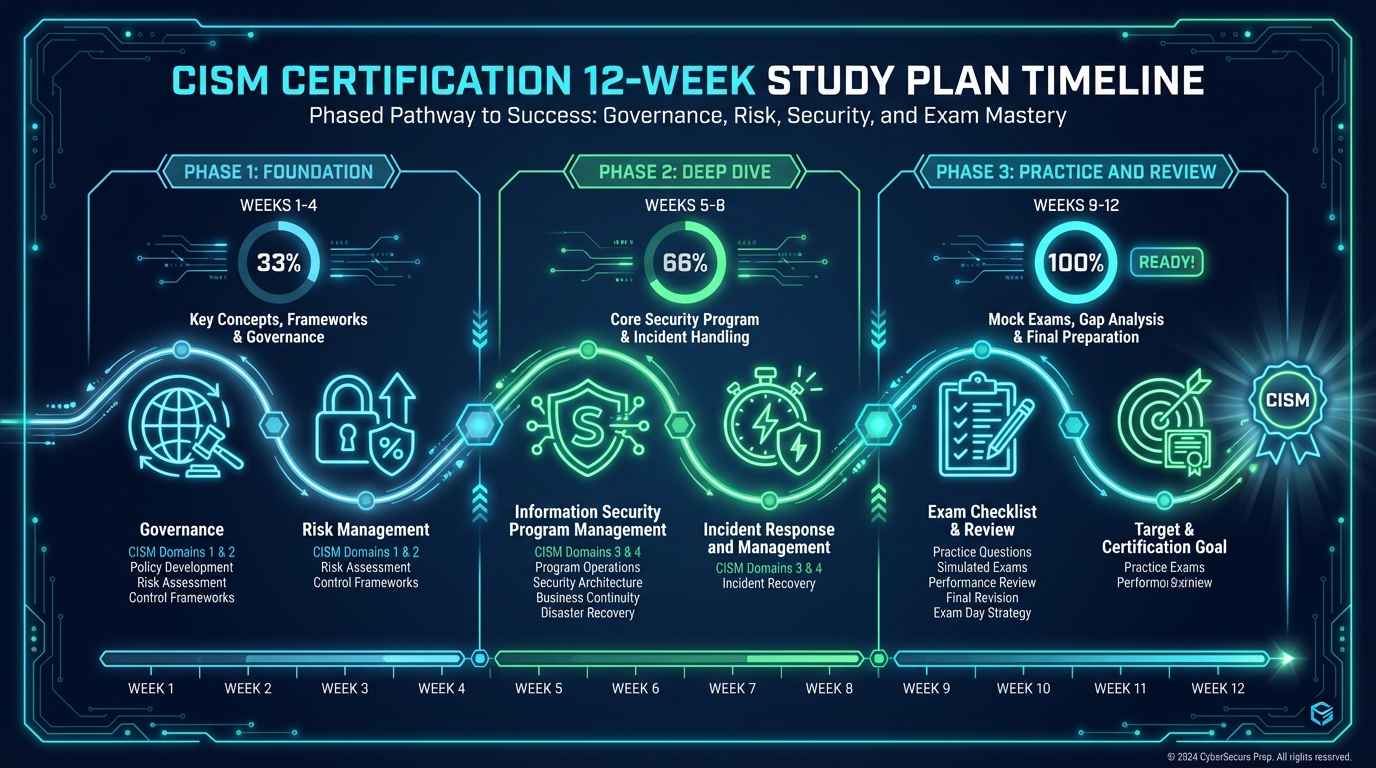
The Certified Information Security Manager (CISM) certification from ISACA is one of the most respected credentials in information security management. But with four complex domains and a reputation for scenario-heavy questions, many candidates struggle to build an effective study plan.
This 12-week CISM study plan gives you a structured, week-by-week schedule to cover every domain thoroughly, practice with realistic questions, and walk into your exam with confidence. Whether you're a security manager looking to formalize your expertise or an IT professional moving into a management role, this guide will get you there.
📖 Table of Contents
- CISM Exam Overview & Domain Weights
- Essential Study Resources
- 12-Week Domain-by-Domain Study Schedule
- Day-by-Day Template: Week 1 (Domain 1 Kickoff)
- Day-by-Day Template: Week 12 (Final Countdown)
- Phase 1: Foundation (Weeks 1–4)
- Phase 2: Deep Dive (Weeks 5–8)
- Phase 3: Practice & Review (Weeks 9–12)
- Sample Weekly Study Schedule
- Expert Study Tips for CISM
- Common Mistakes to Avoid
- Exam Day Strategy
- Frequently Asked Questions
CISM Exam Overview & Domain Weights
Before building your study plan, you need to understand how the CISM exam is weighted. ISACA allocates questions across four domains, but not equally — and that should directly influence how much time you spend on each area.
Domain 1: Information Security Governance
- Exam Weight 17%
- ~Questions 25–26 of 150
- Focus Strategy, frameworks, board-level alignment
- Study Time Weeks 1–2
Domain 2: Information Security Risk Management
- Exam Weight 20%
- ~Questions 30 of 150
- Focus Risk assessment, treatment, monitoring
- Study Time Weeks 3–4
Domain 3: Information Security Program
- Exam Weight 33%
- ~Questions 49–50 of 150
- Focus Program development, management, resources
- Study Time Weeks 5–7
Domain 4: Incident Management
- Exam Weight 30%
- ~Questions 45 of 150
- Focus Response planning, detection, recovery
- Study Time Weeks 7–8
Essential Study Resources
You don't need a library of books to pass the CISM. Focus on these core resources:
Primary Resources (Must-Have)
- Official Guide CISM Review Manual — ISACA's official study guide covering all four domains
- Question Bank ISACA QAE Database — 1,047 official practice questions with explanations
- Content Outline CISM Exam Content Outline — Free from ISACA, maps every task and knowledge statement
Supplementary Resources (Recommended)
- Video Course Online video training (Destination Certification, Cybrary, or LinkedIn Learning CISM courses)
- Practice Platform CISSP.app practice questions with AI-powered gap analysis
- Study Group Reddit r/CISM, TechExams forums, or local ISACA chapter study groups
- Flashcards Create your own or use Anki decks for key terms and frameworks
12-Week CISM Study Schedule: Week by Week, Domain by Domain
This is the section most CISM candidates need and can't find anywhere: a concrete, week-by-week schedule tied to specific domains, study hours weighted by exam impact, and clear checkpoints to keep you on track. Use this as your operating manual for the full 12 weeks.
The schedule below weights your time by what the exam actually tests. Domains 3 and 4 represent 63% of your exam — your calendar should reflect that. Every week lists the domain focus, recommended study hours, which ISACA resources to use, and what "on track" looks like.
Week 1 — Domain 1: Security Governance Foundations (12 hrs)
- Domain Domain 1: Information Security Governance (17%)
- Topics Corporate vs. security governance, board-level roles, governance frameworks (COBIT, ISO 27001, NIST CSF)
- ISACA QAE Complete 25–30 Domain 1 questions; review every explanation regardless of score
- Review Manual Chapters covering governance structure, accountability, and information security strategy alignment
- Hours 5 hrs reading + 4 hrs practice questions + 3 hrs review/flashcards
- ✅ Checkpoint You can explain how security governance integrates with corporate governance and describe the board's accountability role without referring to notes
Week 2 — Domain 1: Strategy, Metrics & Governance Reporting (12 hrs)
- Domain Domain 1: Information Security Governance (17%)
- Topics Information security strategy development, KPIs, KRIs, security steering committees, policy frameworks, budget alignment
- ISACA QAE Complete 50 Domain 1 questions; target 65%+ score; flag any concept scoring below 50%
- Review Manual Chapters on strategy development, resource management, and governance metrics
- Hours 4 hrs reading + 5 hrs practice questions + 3 hrs weak-area review
- ✅ Checkpoint Score 65%+ on a 50-question Domain 1 practice set. You can articulate the difference between KPIs and KRIs and explain how security strategy derives from business objectives
Week 3 — Domain 2: Risk Identification & Assessment (12 hrs)
- Domain Domain 2: Information Security Risk Management (20%)
- Topics Asset classification, threat and vulnerability identification, qualitative vs. quantitative risk assessment, inherent vs. residual risk, risk registers
- ISACA QAE Complete 50 Domain 2 questions; compare your instinctive answers with ISACA's management-oriented rationale
- Review Manual Risk assessment chapters: asset identification, threat modeling, vulnerability assessment methodologies
- Hours 5 hrs reading + 4 hrs practice questions + 3 hrs scenario review
- ✅ Checkpoint Walk through a complete risk assessment for a hypothetical scenario from memory. You can calculate residual risk conceptually and explain why inherent risk ≠ residual risk
Week 4 — Domain 2: Risk Treatment, Appetite & Monitoring (12 hrs)
- Domain Domain 2: Information Security Risk Management (20%)
- Topics Risk treatment options (accept, mitigate, transfer, avoid), risk appetite vs. risk tolerance, risk owners, continuous risk monitoring, risk reporting to leadership
- ISACA QAE Complete 75 Domain 2 questions; re-do any sub-topic below 60%
- Review Manual Risk treatment and monitoring chapters; ISACA's risk management lifecycle
- Hours 4 hrs reading + 5 hrs practice questions + 3 hrs review
- ✅ Checkpoint Score 65%+ on a 75-question Domain 2 set. You can explain risk treatment options using business language and describe how risk appetite differs from risk tolerance with concrete examples
Week 5 — Domain 3: Security Program Development (14 hrs)
- Domain Domain 3: Information Security Program (33%) — heaviest domain
- Topics Program charter and objectives, security architecture, aligning program with organizational strategy, integrating security into SDLC, data classification and handling
- ISACA QAE Begin Domain 3 question sets; complete 50 questions; focus on understanding ISACA's "program-first" reasoning pattern
- Review Manual Program development chapters: objectives, policies, standards, procedures, and program alignment
- Hours 6 hrs reading + 5 hrs practice questions + 3 hrs notes and flashcards
- ✅ Checkpoint You can describe the relationship between a security program and the information security strategy, and explain why SDLC integration matters from a management perspective
Week 6 — Domain 3: Program Management, Training & Third Parties (14 hrs)
- Domain Domain 3: Information Security Program (33%)
- Topics Security awareness and training program design, measuring training effectiveness, third-party and vendor risk management, security culture, resource management and budgeting
- ISACA QAE Complete 75 Domain 3 questions; pay close attention to vendor/third-party scenarios
- Review Manual Chapters on program management, human factors, vendor oversight, and security culture
- Hours 5 hrs reading + 6 hrs practice questions + 3 hrs review
- ✅ Checkpoint You can design a basic security awareness program and explain how to manage third-party risk from a governance perspective — not just contractual checklists
Week 7 — Domain 3 Close + Domain 4 Introduction (14 hrs)
- Domains Domain 3 wrap-up (controls, monitoring) + Domain 4: Incident Management intro
- Topics (D3) Security controls framework, control testing and monitoring, reporting program effectiveness to senior management
- Topics (D4) Incident management planning, IRP development, incident classification, IR team structure and roles
- ISACA QAE 50 Domain 3 (controls focus) + 30 Domain 4 intro questions
- Hours 5 hrs D3 + 5 hrs D4 + 4 hrs practice questions and review
- ✅ Checkpoint Score 65%+ on a 100-question Domain 3 cumulative set. You can explain the difference between an incident response plan and a business continuity plan and when each applies
Week 8 — Domain 4: Detection, Response & Recovery (14 hrs)
- Domain Domain 4: Incident Management (30%) — second heaviest domain
- Topics Incident detection and escalation, containment and eradication strategies, digital forensics basics, post-incident review, lessons learned integration, BCP/DRP integration with incident management
- ISACA QAE Complete 100 Domain 4 questions over the week; target 65%+
- Review Manual Incident response lifecycle chapters; crisis communications; forensic evidence handling
- Hours 5 hrs reading + 6 hrs practice questions + 3 hrs scenario review
- ✅ Checkpoint Score 65%+ on 100 Domain 4 questions. Walk through the complete incident response lifecycle — detect, classify, respond, recover, review — without notes. You can explain containment vs. eradication without confusing them
Week 9 — First Full Mock Exam + Gap Analysis (15 hrs)
- Focus Comprehensive review — all 4 domains
- Activities Take a full 150-question timed mock exam (4-hour session). Score each domain separately. Build a "weakness map" listing every sub-topic below 65%. Re-read Review Manual sections for any weak area
- ISACA QAE Use remaining question pool for targeted domain review after mock exam
- Hours 4 hrs mock exam + 5 hrs detailed review + 6 hrs targeted weak-area study
- ✅ Checkpoint Overall mock exam score 65%+. No individual domain below 55%. Weakness map complete and prioritized for Week 10
Week 10 — Targeted Remediation + Second Mock Exam (15 hrs)
- Focus Weak domains and scenario-based questions
- Activities Drill weak domains identified in Week 9 (50–75 questions per weak domain). Focus on scenario question patterns. Review flashcards for key ISACA terms, frameworks, and concepts. Take second full 150-question mock exam at end of week
- Hours 8 hrs targeted practice + 3 hrs flashcard review + 4 hrs mock exam
- ✅ Checkpoint Second mock exam score 70%+. All four domains at 65%+. Weak spots from Week 9 noticeably improved
Week 11 — Scenario Mastery & ISACA Terminology (12 hrs)
- Focus Scenario question fluency and ISACA-specific language
- Activities Complete 50 scenario-heavy practice questions per day (Mon–Fri). Practice identifying what the question is really asking beneath the scenario. Review ISACA's official CISM Terminology List. Study answer elimination strategies for "most" and "best" questions
- Hours 9 hrs scenario practice + 3 hrs terminology and exam strategy review
- ✅ Checkpoint You consistently choose the management-level answer over the technical one. You recognize ISACA's framing patterns and can eliminate two wrong answers quickly on most questions
Week 12 — Final Mock Exam + Light Review + Exam Day Prep (10 hrs)
- Focus Confidence building — no new material
- Activities Take final mock exam (Monday or Tuesday) — target 75%+. Review your weakness map one final time. Light flashcard pass mid-week. No new material after Wednesday. Rest, logistics prep, early bedtimes. Exam day!
- Hours 4 hrs final mock + 4 hrs light review + 2 hrs logistics/prep
- ✅ Checkpoint Final mock exam 75%+. You feel calm, not frantic. You know your strongest and weakest domains. You have your exam confirmation, ID, and logistics sorted
Day-by-Day Study Template: Week 1 (Domain 1 Kickoff)
The first week sets your habits for the entire 12-week journey. Follow this daily template to build momentum and establish the discipline that will carry you through.
Week 1 Day-by-Day: Domain 1 — Information Security Governance
- Monday Read: What is information security governance? How does it differ from IT governance? Corporate governance accountability model. (45 min). Do 15 QAE Domain 1 questions. (30 min)
- Tuesday Read: Governance frameworks overview — COBIT, ISO 27001, NIST CSF applied to governance (not just compliance). (45 min). Flashcard creation: 10 key governance terms. (30 min)
- Wednesday Read: Board and senior management roles in information security. Security steering committees. Audit committees. (45 min). Do 20 QAE Domain 1 questions; review every explanation. (45 min)
- Thursday Read: Governance program components — policies, standards, procedures, guidelines. Policy hierarchy. (45 min). Teach back: Explain corporate vs. security governance out loud as if presenting to a CFO. (30 min)
- Friday Review: Re-read flashcards, revisit any section that felt unclear this week. (30 min). Do 20 QAE Domain 1 questions. (45 min)
- Saturday Deep session: Read strategy development and accountability chapters (2 hrs). Do 50 Domain 1 QAE questions in one sitting under light time pressure — 90 sec/question. (1.5 hrs). Review every wrong answer with full explanation. (1 hr)
- Sunday Review session: Summarize the week's key concepts in your own words (write it out — 1 page). Update flashcard deck. Review wrong answers from Saturday. Set goals for Week 2. (2–3 hrs total)
Day-by-Day Study Template: Week 12 (The Final Countdown)
Week 12 is not about learning anything new. It's about consolidating what you know, eliminating anxiety, and arriving at your exam well-rested and confident. Cramming new material this week typically hurts more than it helps.
Week 12 Day-by-Day: Final Review & Exam Day
- Monday Final full-length mock exam: 150 questions, 4-hour timed session. Treat it like the real thing — no breaks, no looking things up. Score by domain. (4 hrs). Light review of results — identify your top 3 remaining weak spots only. (1 hr)
- Tuesday Targeted review of your top 3 weak spots from Monday's exam — 30 minutes per topic maximum. Review your master flashcard deck at a high level. (2–3 hrs). Confirm exam logistics: appointment time, location or online setup, required ID, system requirements if remote
- Wednesday Final flashcard pass: governance frameworks, risk treatment options, incident response phases, key ISACA terms. (1.5 hrs). Read your one-page summaries from Week 1 and Week 8. That's it. No new chapters. (1 hr)
- Thursday Light day — 30 minutes maximum of review. Re-read your weakness map. Remind yourself of the exam strategy: first-pass all questions, flag uncertain ones, return to flagged items. Get to bed early
- Friday (Exam Eve) No studying. Seriously. Lay out your ID and any needed items. Do something relaxing. Eat well. Sleep by 10 PM. Your brain consolidates learning during sleep — let it work
- Exam Day Eat a real breakfast. Arrive 30 min early (or log in 20 min early for online). First pass: answer confident questions, flag uncertain ones (aim to get through all 150 in 2.5 hrs). Second pass: return to flagged questions. Final check: ensure no unanswered questions. Trust your preparation
Phase 1: Foundation (Weeks 1–4)
The first four weeks are about building a solid understanding of the first two CISM domains: Information Security Governance and Information Security Risk Management. These are the "strategic" domains — they're about aligning security with business objectives, which is the CISM's entire philosophy.
Weeks 1–2: Information Security Governance (17%)
Domain 1 sets the stage for everything else. You'll learn how security governance integrates with corporate governance, how to develop an information security strategy, and how to measure program effectiveness.
- Week 1: Read the CISM Review Manual chapters on governance. Understand the relationship between security governance and corporate governance. Study frameworks like COBIT, ISO 27001, and NIST CSF as they apply to governance structures.
- Week 2: Focus on security strategy development, resource management, and metrics. Practice 50–75 Domain 1 questions from the QAE database. Review every wrong answer thoroughly.
Weeks 3–4: Information Security Risk Management (20%)
Domain 2 is where governance meets reality. Risk management is about identifying, assessing, and treating risks in a way that makes business sense — not just plugging every hole.
- Week 3: Study risk identification and assessment methodologies — both qualitative and quantitative. Understand asset classification, threat modeling, vulnerability assessment, and how to calculate residual risk. Know the difference between inherent and residual risk.
- Week 4: Focus on risk treatment options (accept, mitigate, transfer, avoid) and how to monitor risk over time. Study risk registers, risk appetite vs. risk tolerance, and the role of risk owners. Practice 75–100 Domain 2 questions.
Phase 2: Deep Dive (Weeks 5–8)
This is where the majority of your CISM exam content lives. Domains 3 and 4 are worth 63% of the exam, so you'll spend four weeks going deep on information security program development and incident management.
Weeks 5–7: Information Security Program (33%)
Domain 3 is the largest single domain and covers everything about building and managing a security program. This is the operational core of what a CISM professional does day-to-day. If you're already working in security management, much of this will feel familiar — but don't skip the study. The exam tests specific ISACA perspectives that may differ from your real-world approach.
- Week 5: Study security program development and alignment with the information security strategy. Understand how to define program objectives, establish security architectures, and integrate security into system development lifecycles (SDLC).
- Week 6: Focus on security program management — resource allocation, security awareness and training programs, and managing third-party and vendor risks. Study how to build a security culture across the organization and manage the human element of security.
- Week 7: Deep dive into security controls, monitoring, and reporting. Understand how to measure program effectiveness, manage security technologies, and communicate results to stakeholders. Practice 100–125 Domain 3 questions over the three weeks.
Weeks 7–8: Incident Management (30%)
Domain 4 is the second-heaviest domain and tests your ability to plan for, detect, respond to, and recover from security incidents. Notice that week 7 overlaps — you'll split it between finishing Domain 3 and starting Domain 4.
- Week 7 (second half): Study incident management planning — how to develop an incident response plan, define roles and responsibilities, establish communication protocols, and set up an incident response team. Understand BCP/DRP integration.
- Week 8: Focus on incident detection, classification, response procedures, and post-incident review. Study forensic evidence handling, containment strategies, eradication, and lessons learned processes. Practice 100+ Domain 4 questions.
Phase 3: Practice & Review (Weeks 9–12)
The final four weeks are all about reinforcement, practice testing, and closing knowledge gaps. This phase separates candidates who pass from those who don't.
Week 9: Full Practice Exams Begin
- Take your first full-length 150-question practice exam under timed conditions (4 hours)
- Review every single question — right and wrong — and note weak areas
- Create a "weakness map" showing which domains and sub-topics need more attention
- Re-read relevant Review Manual sections for any area below 65%
Week 10: Targeted Review
- Focus exclusively on your weak areas identified in Week 9
- Do domain-specific question sets (50–75 questions per weak domain)
- Review flashcards for key terms, frameworks, and acronyms
- Take a second full-length practice exam at end of week — target 70%+
Week 11: Scenario Mastery
- The CISM exam is scenario-heavy — practice reading long scenarios and identifying what's actually being asked
- Focus on "best" and "most important" answer choices — CISM loves these qualifier words
- Do 50 scenario-based questions per day, paying attention to management-level reasoning
- Review the ISACA glossary — the exam uses specific terminology
Week 12: Final Push
- Take a final full-length practice exam early in the week — target 75%+
- Light review only for the rest of the week — avoid cramming new material
- Review your notes, flashcards, and "weakness map" at a high level
- Get proper sleep the two nights before your exam
- Prepare logistics: ID, exam location or online testing setup, comfortable clothing
Sample Weekly Study Schedule
Most CISM candidates are working professionals. Here's a realistic weekly schedule that requires about 10–15 hours per week:
Weekly Time Breakdown
- Monday–Friday 1–1.5 hours/day: Read study material or watch video lectures during commute or lunch
- Saturday 3–4 hours: Deep study session — work through complex topics and practice questions
- Sunday 2–3 hours: Review the week's material, do practice questions, update flashcards
- Total 10–15 hours/week × 12 weeks = 120–180 hours total study time
Expert Study Tips for CISM
These strategies come from successful CISM candidates and align with how the exam actually tests you:
- Think Business First: Every CISM question has a business context. The correct answer is always the one that best serves the organization's objectives while managing risk appropriately. Security for security's sake is never the right answer.
- Master the ISACA Mindset: ISACA has specific perspectives on how security management should work. Their official material represents the "gold standard" answer even if your real-world experience differs. Learn ISACA's way.
- Understand "Most" and "Best": Many CISM questions present four plausible answers. Look for the answer that is most correct from a management perspective — usually the one addressing root cause, policy, or governance rather than tactical response.
- Connect the Domains: The four CISM domains aren't isolated — they form a continuous cycle. Governance sets direction, risk management identifies threats, the security program implements controls, and incident management handles failures. Questions often test your understanding of these connections.
- Use Elimination: On tough questions, eliminate obviously wrong answers first. Technical-only answers and answers that bypass management approval are usually wrong.
- Review Explanations: When doing practice questions, read the explanation for every answer — including the ones you got right. Understanding why an answer is correct deepens comprehension more than just tallying scores.
Common Mistakes to Avoid
Years of CISM exam data show these recurring traps. Avoid them and you're already ahead of many candidates:
- Studying only one resource: The Review Manual alone isn't enough. You need practice questions to develop exam-taking skills and expose knowledge gaps. Combine reading with active testing from week 1.
- Thinking too technically: If you're choosing answers that involve deploying specific tools or configuring systems, you're thinking at the wrong level. Step up to the management perspective.
- Skipping the lighter domains: Domain 1 is only 17%, but governance questions set the context for everything else. A weak foundation leads to confusion in the heavier domains.
- Cramming in the final week: The CISM tests management judgment, which can't be memorized in a few days. Consistent, spaced study over 12 weeks beats a frantic final push every time.
- Ignoring practice exam timing: At 150 questions in 4 hours, you have about 1 minute 36 seconds per question. Practice under timed conditions to build pacing instinct.
- Not reviewing wrong answers: Getting a question wrong is only useful if you understand why. Keep a running log of missed questions and the reasoning behind the correct answer.
Exam Day Strategy
Your 12 weeks of preparation culminate in 4 hours at the testing center (or online). Here's how to make them count:
- Arrive early: Get to the testing center 30 minutes before your appointment. For online exams, test your setup the day before and close all unnecessary applications.
- First pass (2.5 hours): Go through all 150 questions, answering the ones you're confident about and flagging uncertain ones. Don't spend more than 90 seconds on any single question in the first pass.
- Second pass (1 hour): Return to flagged questions with fresh eyes. Often the answer becomes clearer after seeing related questions later in the exam.
- Final review (30 minutes): Check for unanswered questions and review any where you changed your answer. Trust your first instinct unless you find a clear reason to change.
- Stay calm: If you hit a streak of hard questions, it doesn't mean you're failing. The exam uses a scaled scoring system, and some questions may be unscored pilot items. Focus on each question individually.
Frequently Asked Questions
How long does it take to study for the CISM exam?
Most successful candidates study for 8–16 weeks, with 10–15 hours per week. This 12-week plan aims for 120–180 total hours of study, which is the sweet spot for working professionals. Candidates with extensive security management experience may need less time, while those newer to management roles may need more.
Can I pass the CISM without management experience?
You can absolutely sit the exam without full management experience — and many people do. However, the exam heavily tests management judgment and decision-making. If you don't have hands-on management experience, spend extra time on scenario-based practice questions to develop the "manager mindset."
How is the CISM different from the CISSP?
The CISM vs CISSP question is common. In short: CISM focuses on information security management and governance, while CISSP covers a broader technical scope across 8 domains. CISM is ideal for security managers and directors, while CISSP suits security practitioners and architects. Many professionals earn both.
What happens if I fail the CISM exam?
You can retake the CISM exam after a waiting period. ISACA allows you to reschedule with no additional fee if done in time, or pay a retake fee. Most candidates who follow a structured study plan pass on their first attempt. If you do need to retake, your practice exam scores and weakness map will tell you exactly where to focus.
Is the CISM worth it in 2026?
Absolutely. CISM consistently ranks among the highest-paying IT certifications, with average salaries exceeding $140,000. With increasing regulatory requirements and board-level focus on cybersecurity, demand for certified security managers continues to grow. The certification also satisfies requirements for many government and enterprise security roles.
Ready to Start Preparing?
Practice with thousands of expert-verified CISM and CISSP questions. AI-powered gap analysis tells you exactly where to focus.
Start Free 7-Day Trial →Related Guides
CISM Domains Explained: Complete Guide to All 4 Domains (2026)
Deep-dive into each CISM domain — weights, key topics, and what ISACA actually tests. Essential reading before starting Week 1 of this study plan.
CISM Exam Format 2026: 150 Questions, 4 Hours — What to Expect
Understand the exam structure, adaptive scoring, and what a 450/800 passing score actually means before you sit. Know what you're walking into.
CISM vs CISSP: Which Is Better for Security Managers? (2026)
Deciding between CISM and CISSP — or planning to earn both? This comparison breaks down which cert fits your career stage and goals.