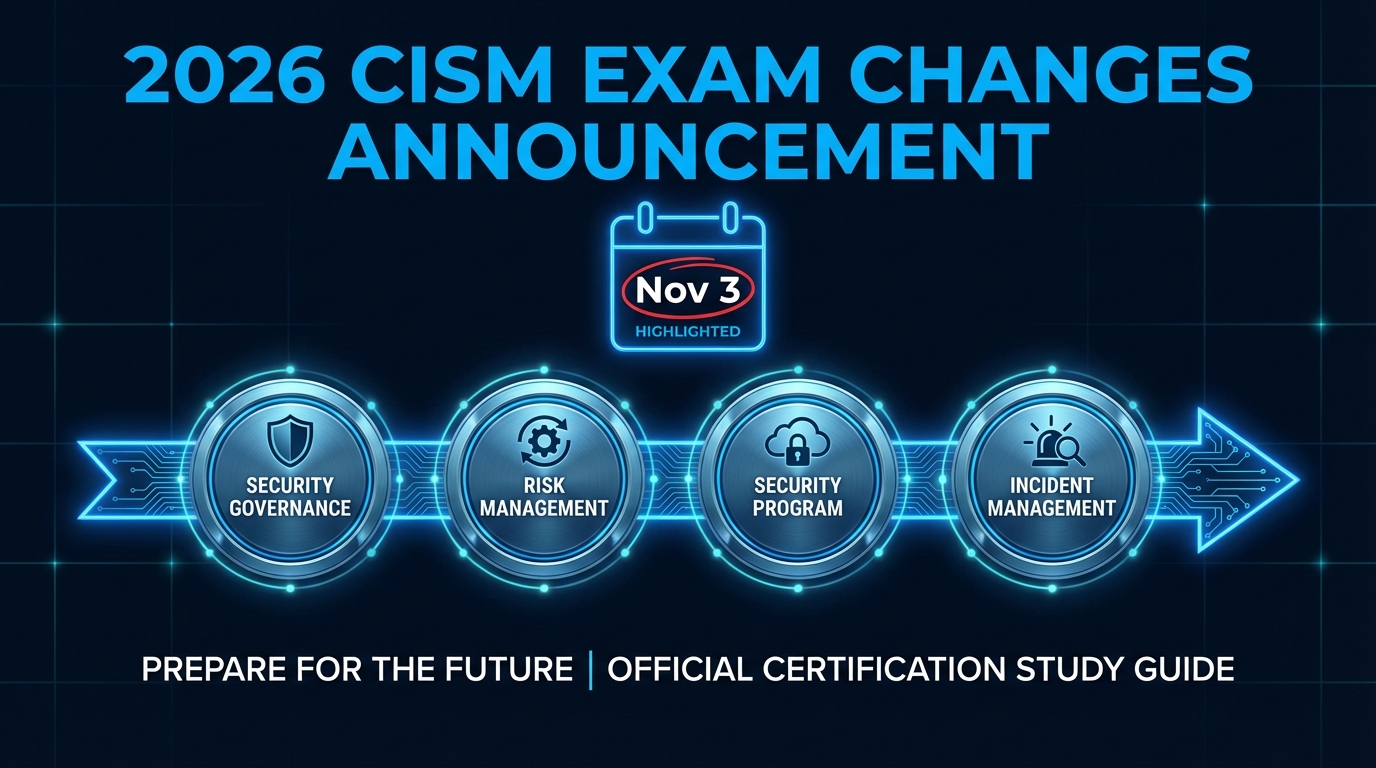
ISACA has officially confirmed that the CISM Exam Content Outline will be updated effective November 3, 2026. That notice is posted directly on the ISACA website and gives candidates roughly nine months to decide: take the exam under the current outline or adapt to the new one.
If you're currently studying for the CISM — or planning to start — this change directly affects your strategy. This guide explains what we know about the 2026 CISM exam changes, what's likely to shift in the new content outline, and how to position your study plan for success whether you test before or after November 3rd.
📋 Table of Contents
What ISACA Has Confirmed About the 2026 Change
ISACA's official CISM certification page now carries a prominent disclaimer: "The CISM Exam Content Outline will be updated effective 3 November 2026. Starting on that date the CISM Exam will reflect the new Exam Content Outline."
This is a standard part of ISACA's credentialing lifecycle. Every three to five years, ISACA conducts a global Job Practice Analysis (JPA) — a research study that surveys thousands of active security managers to understand how the role has evolved. The JPA results drive updates to the exam content outline, ensuring the CISM remains relevant to what practitioners actually do on the job.
The last major CISM update came in June 2022, when ISACA restructured the exam from five domains down to four and reweighted the content significantly. Before that, the domains were last revised in 2017. So this 2026 update follows the typical 4-year cycle — and given how dramatically the security landscape has shifted since 2022, a meaningful update is well overdue.
At the time of writing, ISACA has not yet published the full new content outline. When it's released (typically a few months before the effective date), you'll find it at the official ISACA CISM Exam Content Outline page. We'll update this article as more details become available.
Current CISM Exam Format (Pre-November 2026)
Before diving into what's changing, it helps to understand what you're working with today. The current CISM exam format has been in place since the 2022 update:
Current CISM Exam Snapshot (2022–2026)
- Number of Questions 150 multiple-choice questions
- Time Allotted 4 hours (240 minutes)
- Scoring Scale 200–800 points
- Passing Score 450 or higher
- Question Format Scenario-based, application-level questions
- Domains 4 domains
- Delivery Computer-based testing at Pearson VUE centers or online proctored
- Language Options English, Chinese Simplified, Spanish, Japanese, Korean
One thing that doesn't change with a content outline update: the exam's fundamental format and testing methodology. CISM questions are notoriously scenario-based — you won't see simple recall questions like "what does BCP stand for." Instead, you'll get complex situations requiring you to think like a security manager, not a practitioner. That philosophy is baked into the CISM's DNA and is very unlikely to change in 2026.
For a deeper look at the current exam structure, see our guide to the CISM domains explained.
Current Domain Breakdown & Weightings
The 2022 update consolidated what was previously a five-domain exam into four tightly focused areas. Here's how the current exam is weighted:
Domain 1 — Information Security Governance
- Weight 17% (~26 questions)
- Key Topics Security strategy, governance frameworks, stakeholder management, policy development, business cases for security
Domain 2 — Information Security Risk Management
- Weight 20% (~30 questions)
- Key Topics Risk assessment, threat landscape, vulnerability analysis, risk treatment options, risk monitoring and reporting
Domain 3 — Information Security Program
- Weight 33% (~50 questions)
- Key Topics Program resources, asset classification, security controls, testing & evaluation, awareness training, third-party management
Domain 4 — Incident Management
- Weight 30% (~45 questions)
- Key Topics Incident response planning, BIA, BCP, DRP, containment, eradication, post-incident review
Notice that Domains 3 and 4 together make up 63% of the exam. If you're currently studying, don't neglect Domain 1 — but don't spend equal time on all four domains as if they're weighted equally. Your study time should roughly mirror the domain weights.
Our full breakdown of each domain's subtopics is covered in the CISM domains guide. For a week-by-week plan that allocates study time proportionally, check the CISM study plan.
What's Likely to Change in the New 2026 Outline
While ISACA hasn't published the full new content outline yet, we can make educated predictions based on how the security management field has evolved since 2022. The Job Practice Analysis surveys real-world CISMs about their day-to-day responsibilities — and a lot has changed in four years.
AI and Machine Learning Security Governance
This is the elephant in the room. Since 2022, AI has gone from a niche concern to a boardroom priority. Security managers are now expected to understand AI risk governance — including how to assess AI system risks, govern AI model development and deployment, and advise senior leadership on AI-related threats. ISACA has already launched the Advanced in AI Security Management (AAISM) certification (which requires CISM as a prerequisite), signaling how central AI governance has become to the CISM role. Expect AI risk topics to appear explicitly in the updated outline, particularly in Domains 1 and 2.
Expanded Third- and Fourth-Party Risk
Supply chain attacks have dominated headlines since 2020 (SolarWinds, Kaseya, MOVEit). The current Domain 3 mentions "management of external services" as a subtopic, but given the scale of supply chain risk in 2026, expect this to get expanded coverage — potentially including fourth-party risk, software bill of materials (SBOM) governance, and vendor security program maturity assessment.
Updated Regulatory and Compliance Landscape
The regulatory environment has transformed dramatically since 2022. Key frameworks and regulations now in force include:
- DORA (Digital Operational Resilience Act) — EU financial sector regulation with direct incident reporting and resilience testing requirements
- NIS2 Directive — Updated EU network and information security rules with broader sector scope
- SEC Cybersecurity Rules — Mandatory incident disclosure requirements for US public companies
- NIST CSF 2.0 — Major update to the Cybersecurity Framework, now including a governance function
- ISO/IEC 27001:2022 — Updated international standard with 11 new controls
Security managers in 2026 are expected to navigate this complex multi-jurisdictional landscape. The updated exam will almost certainly reflect this expanded regulatory environment.
Cloud Security Governance
Cloud computing was already mainstream in 2022, but security managers' responsibilities around cloud governance have matured significantly. Shared responsibility models, cloud security posture management (CSPM), and multi-cloud risk management are now standard job functions for CISM-level professionals. Expect sharper cloud governance content in Domain 1 and cloud-specific risk assessment in Domain 2.
Zero Trust Architecture Governance
Zero trust has shifted from trend to baseline expectation in enterprise security programs. The security manager's role in overseeing ZTA implementation — setting governance policies, measuring progress, and communicating ZTA strategy to leadership — is a real-world CISM responsibility that the updated exam is likely to address.
Could the Number of Domains Change?
Possibly, but unlikely. The 2022 reduction from five to four domains was a significant structural change, and ISACA spent years validating that structure through its JPA. A further consolidation or expansion of domains so soon after the last restructure would be unusual. More likely, we'll see domain weight adjustments (perhaps increasing Domain 2 to reflect the elevated importance of risk management in the AI era) and new or revised subtopics within the existing four-domain framework.
Should You Test Before or After November 3, 2026?
This is the question every current CISM candidate is asking. Here's a clear framework:
Take the Exam Before November 3, 2026 If…
- You've already been studying for months using current materials
- You're 60%+ through your study plan and tracking well on practice exams
- Your target test window is April–October 2026
- You prefer certainty — the current content outline is fully published and your study resources are aligned
- You're confident in the current domain structure and don't want to re-learn updated weightings
Wait for the New Exam (Post-November 2026) If…
- You're just starting to study now (February 2026 or later)
- Your career goals involve AI security governance, DORA compliance, or cloud-heavy roles — where the new content will be directly relevant
- You prefer having current study materials once the new outline is published (typically ~3 months before the effective date)
- You're not in a rush and can afford to wait until Q1 2027 to sit the exam
The bottom line: there's no definitively "easier" window. The CISM has always been a difficult, scenario-heavy exam. What matters most is how prepared you are — not which side of November 3rd you test on. If you're well into your studies now, push for a Q2 or Q3 2026 exam date. If you're starting fresh, target Q1 2027 with updated materials.
Study Strategy for Both Timelines
Strategy 1: Testing Before November 2026
If your goal is to pass under the current content outline, your study approach should be straightforward:
- Use current-edition resources — ISACA's official CISM Review Manual (current edition), ISACA practice questions, and review courses published in 2023 or later.
- Weight your study time by domain — Domain 3 (33%) and Domain 4 (30%) deserve the most attention. Many candidates make the mistake of spreading time equally across all four domains.
- Focus on management-level thinking — Every CISM question tests your ability to think like a manager, not a technician. When choosing answers, ask: "What would a CISM-level manager do in this situation?" The most systematic, risk-aware, business-aligned choice is usually correct.
- Book your exam by June 2026 — Gives you buffer in case you need a retake before the November cutover.
See our complete CISM study plan for a 12-week schedule aligned to the current content outline.
Strategy 2: Testing After November 2026
If you're planning to test on the new exam, patience is your best strategy right now:
- Build foundational knowledge now — The core concepts of security governance, risk management, and incident response aren't going away. Time spent deeply understanding these fundamentals will serve you under any content outline version.
- Watch for the updated ECO — ISACA typically publishes the new content outline 3–4 months before the effective date, so look for it around July–August 2026.
- Upskill on likely new areas — Start reading about AI governance frameworks (NIST AI RMF, ISACA's AI governance resources), DORA compliance, and NIST CSF 2.0. This knowledge will be useful professionally regardless of what appears on the exam.
- Wait for updated study materials — Plan your test date for January–March 2027, when ISACA's review manual and third-party courses will reflect the new outline.
Practice Questions: The Universal Preparation Tool
Regardless of which timeline you choose, consistent practice with realistic CISM-style questions is the single most effective preparation method. The CISM's scenario-based approach requires practice to internalize — you can't read your way to a passing score. Aim for at least 1,000 practice questions before exam day, and analyze every wrong answer to understand the reasoning, not just the correct response.
For scenario-based practice aligned to the CISM's management-level thinking, cissp.app offers an AI-powered question bank with gap analysis to identify exactly where you need to focus.
Frequently Asked Questions
Will my current CISM certification be affected by the 2026 changes?
No. If you're already certified, the 2026 exam update doesn't affect your existing credential. Your CISM remains valid, and your CPE (Continuing Professional Education) requirements for renewal stay the same. The update only affects candidates sitting for the exam.
Do I need to retake the exam after November 2026?
Absolutely not. A content outline update never requires recertification. Once you pass the CISM, you maintain it through annual CPE hours and the triennial renewal fee — the exam is a one-time requirement.
Will the passing score change?
ISACA has not announced any change to the 450 passing score (on the 200–800 scale). Passing score thresholds are set through psychometric analysis of actual exam performance and don't necessarily change with content updates.
Where can I find the new CISM Exam Content Outline when it's released?
The official source is ISACA's CISM Exam Content Outline page. ISACA will also notify registered candidates via email. We'll update this article when the new ECO is published.
What if I fail the exam just before November and need to retake?
ISACA's retake policy requires a 30-day wait after a failed attempt. If you test in October 2026 and don't pass, your retake would fall under the new content outline. Factor this buffer into your timing — ideally test by September 2026 if you want a pre-cutover safety net for retakes.
How does this compare to the last major CISM update in 2022?
The 2022 update was a significant structural change — it reduced the domains from five to four, renamed several domains, and substantially shifted the weightings. Many candidates who had been studying for the pre-2022 exam had to pivot their preparation significantly. The 2026 update may be less structurally dramatic (maintaining four domains) but could introduce meaningful new subtopic content, particularly around AI security and updated regulatory frameworks. We'll know more when ISACA publishes the new ECO.
For more context on the CISM credential overall, including how it compares to other certifications, see our guide on CISM vs CISSP. And if you're building your study schedule, the 12-week CISM study plan shows you exactly how to allocate your time across the current domains.
Ready to Start Preparing?
Practice with thousands of expert-verified CISM and CISSP questions. AI-powered gap analysis tells you exactly where to focus.
Start Free 7-Day Trial →